


Electrical & Electronics Engineering
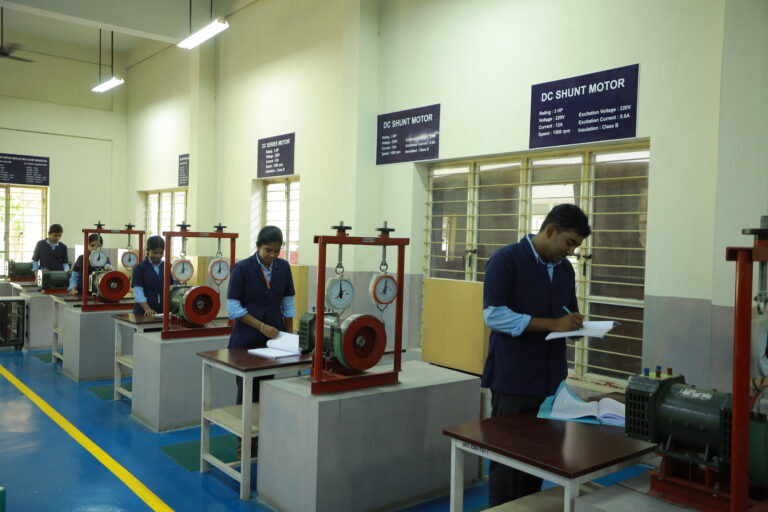
About Department:
It is originated by the Electrical Engineering. By the technical modernization of the world and computerization in our work field, it is necessary to use and understand the circuits and computerized devices in the Electrical & Electronic field. The course also deals with generation of electric power, transmission and distribution.
The Department of Electrical And Electronics Engineering was started in the year 2011. The annual sanctioned intake of B.Tech program in Electrical and Electronics Engineering is 60. The department consists of a team of motivated, dedicated and experienced teachers graduated from institutions of good reputation.
Department Advisory Board
| Sl.No | Board | Member |
|---|---|---|
| 1 | Academia | Dr R Sunitha |
| 2 | Academia | Dr Bindu V |
| 3 | Industry | Mr Hinoj P R |
| 4 | Industry | Ms.Sangeetha N R |
| 5 | Head of Department | Dr.Joly M |
| 6 | Senior Faculty Member | Ms Remya V R |
| 7 | Senior Faculty Member | Ms Latha Thomas |
| 8 | Senior Faculty Member | Ms.Teresa Babu |
| 9 | Alumini | Mr.Dickson |
Vision
Provide quality education in the field of Electrical and Electronics Engineering to create ethically responsible engineers that cater to the needs of the society by imparting skill development, innovation and sustainable development.
Mission
- To provide quality teaching environment through industry institution interactions, qualified faculty and well equipped laboratories.
- Imbibe ethical values among students and prepare them to achieve sustainable development.
- Impart technical skills and innovativeness among students to meet emerging challenges
Programme Offered
| Programme | Intake | Duration |
|---|---|---|
| B.Tech in EEE | 60 | 4 years |
Programme Educational Objective (PEO)
- PEO 1- Graduates will demonstrate strong foundational knowledge and advanced technical skills in electrical and electronics engineering to analyze, design and develop solutions for real world problems.
- PEO 2-Graduates will exhibit ethical values, effective communication and leadership skills while collaborating with multidisciplinary teams to address societal and industrial challenges.
- PEO 3 - Graduates will leverage their technical skills and entrepreneurial mindset to create innovative products, services or ventures considering societal needs.
Program Specific Outcomes (PSO)
- PSO1 - Graduates will be able to apply core concepts of electrical and electronics engineering to design, analyze real life problems in power electronics, electrical machines, power systems, electronics, control and instrumentation.
- PSO2 - Graduates will develop the technical skills and professional mindset required for careers in industries or as entrepreneurs while maintaining ethical and responsible engineering practices.
- PSO3 - Develop and deploy electrical and electronics systems to meet global demands with a view of energy conservation and sustainability.
Programme Outcome (PO)
- PO1-Engineering Knowledge: Apply knowledge of mathematics, natural science, computing, engineering fundamentals and an engineering specialization as specified in WK1 to WK4 respectively to develop to the solution of complex engineering problems.
- PO2-Problem Analysis: Identify, formulate, review research literature and analyze complex engineering problems reaching substantiated conclusions with consideration for sustainable development. (WK1 to WK4).
- PO3-Design/Development of Solutions: Design creative solutions for complex engineering problems and design/develop systems/components/processes to meet identified needs with consideration for the public health and safety, whole-life cost, net zero carbon, culture, society and environment as required. (WK5)
- PO4-Conduct Investigations of Complex Problems: Conduct investigations of complex engineering problems using research-based knowledge including design of experiments, modelling, analysis & interpretation of data to provide valid conclusions. (WK8).
- PO5-Engineering Tool Usage: Create, select and apply appropriate techniques, resources and modern engineering & IT tools, including prediction and modelling recognizing their limitations to solve complex engineering problems. (WK2 and WK6)
- PO6-The Engineer and The World: Analyze and evaluate societal and environmental aspects while solving complex engineering problems for its impact on sustainability with reference to economy, health, safety, legal framework, culture and environment. (WK1, WK5, and WK7).
- PO7-Ethics: Apply ethical principles and commit to professional ethics, human values, diversity and inclusion; adhere to national & international laws. (WK9)
- PO8-Individual and Collaborative Team work: Function effectively as an individual, and as a member or leader in diverse/multi-disciplinary teams.
- PO9-Communication: Communicate effectively and inclusively within the engineering community and society at large, such as being able to comprehend and write effective reports and design documentation, make effective presentations considering cultural, language, and learning differences.
- PO10-Project Management and Finance: Apply knowledge and understanding of engineering management principles and economic decision-making and apply these to one’s own work, as a member and leader in a team, and to manage projects and in multidisciplinary environments.
- PO11-Life-Long Learning: Recognize the need for, and have the preparation and ability for i) independent and life-long learning ii) adaptability to new and emerging technologies and iii) critical thinking in the broadest context of technological change. (WK8)