


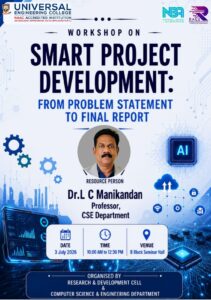
Thrissur, Kerala | July 3, 2026: Universal Engineering College, one of the recognised engineering colleges in Kerala, organised a Smart Project Development: From Problem Statement to Final Report workshop today to help students understand how successful engineering projects are planned, developed, documented, and presented. The session was conducted by Dr. L. C. Manikandan, Professor, Department of Computer Science and Engineering, and was organised by the Research & Development Cell in association with the Department of Computer Science and Engineering at the B Block Seminar Hall.
The workshop brought together students interested in improving their approach to academic projects, particularly final-year project work. Instead of focusing only on technical implementation, the session explained how engineering students can develop projects that solve practical problems while following a structured research process.
A Practical Approach to Engineering Project Development
For many engineering students, the most difficult part of a project is not coding or designing a circuit—it is identifying a meaningful problem to solve. Addressing this challenge, Dr. L. C. Manikandan guided students through every stage of project development, beginning with selecting a relevant problem statement and ending with preparing a professional final report.
The session covered project planning, literature review, research methodology, documentation standards, report writing, presentation techniques, and project evaluation. Students also learned how proper planning during the initial stages can reduce development time and improve the quality of the final outcome.
Rather than presenting theory alone, the workshop included practical examples that demonstrated how engineering concepts can be applied to real-world situations.
Understanding What Makes a Strong Engineering Project
During the interactive session, students discussed the characteristics of a well-planned engineering project. Dr. Manikandan explained that every successful project should begin with understanding a real need rather than selecting a technology first.
“A strong engineering project starts with identifying the right problem. Technology becomes meaningful only when it provides a practical solution,” Dr. L. C. Manikandan said while addressing the participants.
The discussion encouraged students to think critically about project selection and to consider factors such as feasibility, innovation, user requirements, and future scalability before beginning development.
Preparing Students for Modern Engineering Careers
Engineering education is evolving beyond classroom learning. Employers today expect graduates to demonstrate technical knowledge, analytical thinking, communication skills, and the ability to work on practical projects.
According to the All India Council for Technical Education (AICTE), project-based learning helps students strengthen problem-solving, teamwork, innovation, and technical communication—skills that are increasingly valued by industries and recruiters.
Keeping these expectations in mind, the workshop introduced students to current technology domains including:
- Artificial Intelligence (AI)
- Machine Learning
- Internet of Things (IoT)
- Cloud Computing
- Data Science
- Embedded Systems
- Automation Technologies
Participants learned how these technologies can be integrated into engineering projects while maintaining proper documentation and research standards.
Students Participate in Interactive Technical Discussions
The workshop encouraged active participation throughout the session. Students asked questions about project selection, technical documentation, research publications, software tools, and presentation strategies.
Many participants found the practical examples particularly useful because they connected academic learning with industry expectations. The discussions also highlighted common mistakes made during final-year projects and suggested ways to improve project quality from the beginning.
The interactive format allowed students to understand not only how to complete an engineering project but also how to present it confidently during project evaluations, internships, and placement interviews.
Building a Research-Oriented Learning Environment
Research and innovation have become important components of engineering education. Through regular workshops, seminars, technical talks, and skill development programmes, Universal Engineering College encourages students to explore new technologies and develop practical solutions to engineering challenges.
The Research & Development Cell plays an active role in creating opportunities where students can strengthen research methodology, technical writing, project management, and innovation skills alongside their academic curriculum.
Such programmes help students develop confidence while preparing for higher education, industrial training, competitive examinations, and campus recruitment.
Supporting Engineering Education in Kerala
Among the growing engineering colleges in Kerala, Universal Engineering College continues to focus on academic learning supported by practical exposure. Workshops like today’s Smart Project Development session complement classroom teaching by helping students understand how engineering concepts are applied in professional environments.
With experienced faculty members, research-focused activities, modern laboratories, NBA-accredited programmes, and industry-oriented learning initiatives, the college aims to prepare graduates for the changing demands of the engineering profession.
Students are encouraged to participate in technical workshops, innovation programmes, coding activities, research projects, and interdisciplinary learning experiences throughout their academic journey.
Why Project-Based Learning Matters
Engineering projects are often the first opportunity for students to solve real-life problems using technical knowledge. A well-executed project demonstrates analytical thinking, creativity, planning, teamwork, and communication skills.
Project-based learning also helps students:
- Connect classroom concepts with practical applications.
- Improve research and technical documentation skills.
- Develop confidence in presenting technical ideas.
- Build portfolios for internships and campus placements.
- Explore emerging technologies through hands-on learning.
- Strengthen innovation and critical thinking abilities.
These experiences contribute significantly to career readiness and lifelong learning.
Conclusion
The Smart Project Development Workshop conducted at Universal Engineering College provided students with practical insights into every stage of engineering project development—from identifying a meaningful problem statement to preparing a professional final report.
As engineering education continues to emphasise innovation, research, and practical problem-solving, such initiatives help students develop skills that extend far beyond academic requirements. By organising programmes that combine technical knowledge with structured project planning, Universal Engineering College continues to contribute to quality engineering education in Kerala and prepare students for successful careers in technology and engineering.
Frequently Asked Questions
1. What was the Smart Project Development Workshop about?
The workshop focused on the complete engineering project lifecycle, including problem identification, project planning, research methodology, documentation, technical implementation, report writing, and final project presentation. It helped students understand how to develop structured, industry-relevant engineering projects.
2. Who conducted the workshop at Universal Engineering College?
The session was conducted by Dr. L. C. Manikandan, Professor in the Department of Computer Science and Engineering. He shared practical guidance on project development, research practices, and documentation based on academic and technical experience.
3. Why is project-based learning important for engineering students?
Project-based learning allows students to apply theoretical concepts to practical situations. It improves analytical thinking, teamwork, technical communication, research skills, and problem-solving abilities, all of which are valuable during placements and professional careers.
4. Which students benefited from this workshop?
The workshop was especially beneficial for B.Tech students preparing for mini projects, final-year projects, research activities, internships, and technical competitions. Students interested in AI, IoT, software development, and emerging technologies also gained valuable insights.
5. Which department organised the programme?
The workshop was organised by the Research & Development Cell in collaboration with the Department of Computer Science and Engineering at Universal Engineering College.
6. How do workshops improve engineering education?
Technical workshops expose students to practical methodologies, industry practices, research techniques, and emerging technologies. They complement classroom learning by helping students build confidence and develop skills needed for engineering careers.
7. What technologies were discussed during the session?
The workshop included discussions on Artificial Intelligence, Machine Learning, Internet of Things (IoT), Cloud Computing, Data Science, Embedded Systems, Automation, and their applications in engineering projects.
8. Why should students participate in technical workshops?
Technical workshops help students gain practical knowledge, improve project quality, strengthen presentation skills, understand industry expectations, and prepare for campus placements, higher studies, and research opportunities.